
European Rearmament Plans: National Policy Choices Will Shape Fiscal Impact

As geopolitical uncertainties mount, European countries like Germany, France, and the UK are re-evaluating their defence budgets. With the U.S. commitment to European security becoming increasingly unpredictable, these nations recognize the need to bolster their military expenditures.
Key Points
- Germany is in a robust fiscal position, allowing for significant increases in defence spending.
- France and the UK face tighter fiscal constraints that require careful navigation of budget adjustments.
- Debt levels are expected to rise as countries seek to meet NATO’s revised target of 3% of GDP by 2027.
Summary
The dynamics of rearmament in Europe stem from a need for enhanced security in the face of shifting global stability. Germany, with its healthy public finances (government debt at 63% of GDP), is set to lead the charge with increased military investment. In contrast, France, with debt at 113% of GDP, and the UK, at 100%, will struggle with their fiscal implications as they ramp up military spending.
Defence Spending Forecast
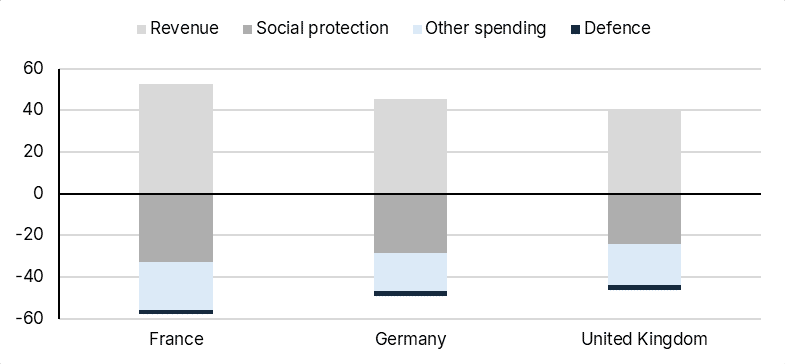
The shift to higher defence budgets means an annual military expenditure shift towards EUR 95 billion for both France and the UK, and over EUR 140 billion for Germany by 2027. This represents an average annual funding increase of EUR 45 billion (0.9pp of GDP) for Germany, without adverse credit impactos. For France and the UK, however, the funding increases could threaten fiscal sustainability and may require trade-offs in social spending.
Fiscal Consequences
As countries increase their defence budgets, significant changes in debt-to-GDP ratios are anticipated, with projections of 120% for France and 109% for the UK, while Germany’s ratio may rise to 69% by 2027. The rise in government debt will likely necessitate budgetary adjustments and could have mixed implications for credit ratings.

Opinion & Analysis
The push for enhanced military spending might give Germany an edge in achieving positive economic growth and stabilizing its post-COVID economy. However, the fiscal strain on France and the UK could lead to reduced funding for other crucial social programs. The challenge remains: How will these countries manage their fiscal policies while committing to NATO’s spending goal?
Germany's strategic expansion in military capabilities could drive growth, but coordination amongst EU members will be vital to ensure a balanced approach to defence spending across the continent.